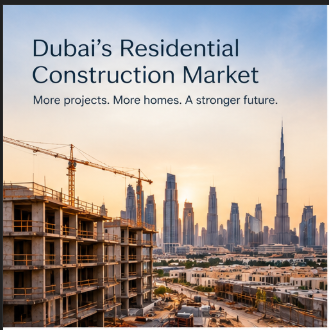
Dubai’s residential real estate market is continuing to expand in 2026, with a growing number of properties moving from planning and construction into completion and handover. New villa communities, apartment developments and large master-planned destinations are adding significant housing supply across the emirate, while strong transaction activity continues to encourage developers to launch further projects.
For the construction industry, this means the focus is increasingly shifting toward delivering larger volumes of high-quality residential properties while meeting changing expectations around design, space, amenities and finishing standards.
A Significant Increase in Completed Developments
The scale of Dubai’s real estate construction activity can be seen in the latest project completion figures. During the first half of 2026, 104 real estate projects were completed, compared with 75 during the same period in 2025. This represents a 38.7% increase in completed projects within one year.
The value attached to those completed developments also increased substantially. Investment in completed projects reached more than AED 111 billion, compared with approximately AED 73 billion during H1 2025 an increase of around 52%. For Dubai’s construction sector, these figures demonstrate that activity is not limited to new project announcements. A significant number of developments are progressing through construction and reaching the final stages of delivery.
More Homes Are Entering the Market
Residential supply has also increased considerably.
Dubai added 24,537 residential units during the first half of 2026, compared with 18,043 units during H1 2025. That represents an increase of approximately 36%.
The completed built-up area followed the same direction, reaching approximately 1.95 million square meters, up from around 1.58 million square meters during the same period last year. This represents growth of approximately 23.4%.
The increase in completed homes is particularly significant for developers and contractors because it reflects the amount of physical construction being delivered rather than simply measuring sales or planned projects.
Major Residential Communities Are Taking Shape
The next stage of Dubai’s residential expansion is already visible through several large developments.
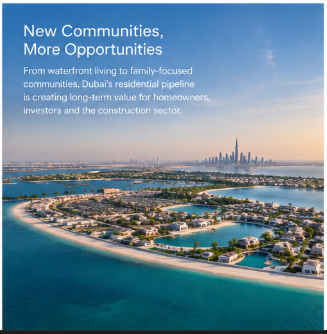
One of the most significant announcements of 2026 came from Aldar and Dubai Holding, which announced plans for almost 14,000 new homes across two Dubai developments. The projects, which include a family-oriented community along the D54 corridor near Nad Al Sheba and a luxury waterfront development at Palm Jebel Ali, have a combined gross development value exceeding AED 38 billion.
Palm Jebel Ali is particularly significant for the luxury residential construction segment, with large villa developments forming an important part of the destination. At the same time, construction continues across established and emerging residential locations including Jumeirah Village Circle, Dubailand, Dubai South, Dubai Islands, Meydan, Jumeirah Village Triangle and Al Furjan.
The result is a market where construction activity is spread across multiple types of communities rather than being concentrated in a single district.
Villa Developments Continue to Attract Demand
While apartments account for a large proportion of Dubai’s residential supply, villa construction continues to represent an important part of the market.
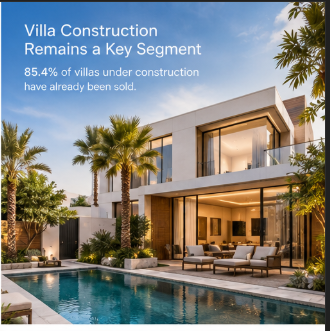
One of the clearest indicators is the sales performance of properties that are still under construction. Approximately 85.4% of villas under construction had already been sold, compared with around 74.1% for apartments.
The figures help explain why developers continue to introduce villa and townhouse communities across Dubai. Larger floor plans, private outdoor areas, gardens and community amenities remain attractive to families and buyers looking for long-term residences.
This demand is creating opportunities across the construction cycle, from structural works and MEP installation to waterproofing, façades, landscaping, interiors and high-end finishing.
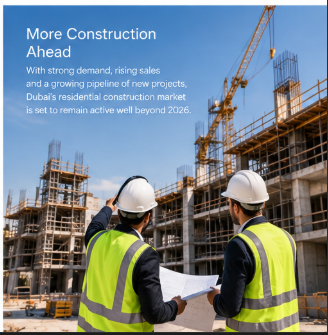
Construction Activity Is Still Expanding
The number of new building permits provides another indication of the development pipeline.
Dubai Municipality issued 10,776 building permits during Q1 2026, representing a 12% increase compared with Q1 2025. The total permitted built-up area reached approximately 3.9 million square meters, which was 48% higher than the previous year.
This is important because permits provide an indication of development activity entering the construction cycle. The increase suggests that the volume of projects moving toward construction remains substantial even as thousands of existing homes are being completed.
What the Next Phase Could Look Like
Dubai’s residential construction market is entering a period where delivery will be just as important as new project launches. With thousands of homes being completed while major communities continue to break ground, developers and contractors will need to maintain consistent construction quality, efficient project coordination and reliable delivery schedules.
The growth in completed projects, residential units and permitted built-up area shows that Dubai’s real estate construction market remains highly active in 2026. For the construction industry, the opportunity extends across the entire residential lifecycle from new villa and apartment construction to fit-outs, renovations and final finishing.
As new communities take shape across Dubai, the projects being constructed today will become the residential neighborhoods that define the next phase of the emirate’s growth.